I’ve recently taken short videos of birds near me.
I have peanut feeders in my garden that hang from an oak tree. There is a holly bush next to it so the birds can hop in and out to safety, ready for when the sparrowhawk appears.
I usually have blue tits, great tits and great spotted woodpeckers on there, but recently some starlings have appeared. I also have magpies and jackdaws in the garden and the jackdaws have tried the feeders as well.
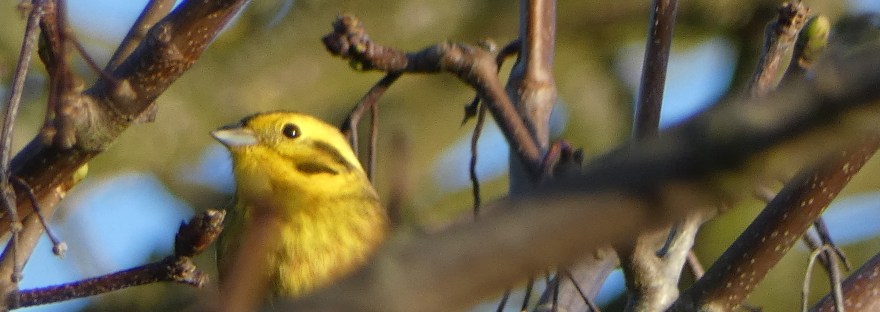
There is a ruined church just down the road, and a flock of finches have taken up residence in the trees and copse. You can hear the linnets chattering away as you pass by. I’ve also seen chaffinches, gold finches, greenfinches, yellowhammers and brambling.
There is a river estuary a short walk away with a nature reserve on the opposite side of the river. The birds don’t know about the reserve so they come on my side of the river as well. There are dunlin, teal, oystercatchers, avocet, knot, godwits – both bar tailed and black-tailed – and many others.
I’m not very good at telling which bird is which, so if I have named them wrongly in the videos, do let me know.
And lastly here is a flock of Brent geese. They travel from the farmer’s field where they overnight down to the estuary. You can always hear them coming.
Nannie RaRa’s latest travel adventure has been to Alaska aboard the Hurtigruten ship MS Roald Amundsen. We saw so much wildlife.
We started and finished in Vancouver.
Vancouver
Our journey started in Vancouver at the Hyatt Regency. We wandered down to the harbour and saw our ship MS Roald Amundsen plus lots of sea planes. Vancouver is a city of man-made waterfalls.
The next day, a coach tour of the city with stops in Chinatown with the narrowest building, then a visit to Stanley Park, our first view of totem poles and our first walk in a forest. The original trees had been cut down 200 years ago, so many of those we saw were 200 years old.
On to the ship.
Sea day inside passage
Our first day was at sea in the inside passage. It was very foggy to start with but this soon cleared. The scenery was captivating with the forests going down to the water’s edge.
We saw some Dall’s porpoises.
We had chance to explore the ship. We also had our first swim in the infinity pool. Coming out a lady pointed out some humpback whales nearby.
We were on deck after lunch and saw the blow and then the backs and tails of many humpback whales.
Misty Fjords
It was foggy first thing but later became sunny and warm. We passed the New Eddystone Rock on our way to Misty Fjords where we had our first outing by zodiac.
The water was very calm. We saw a great blue heron and a bald eagle’s nest.
Wrangell
We started our tour of Wrangell with a botanical walk in the Tongass temperate rain forest. We tried thimble berries, salmon berries, blueberries but not snot berries. The trees were very tall and straight.
We were asked to be noisy so any bears would know we were there. We saw some bear poo with red berries in it on the trail. One lady walking her dog had a radio playing loud music.
We saw a red squirrel in the tree top and saw and heard chickadees. Chickadees are very similar to great tits.
We walked back to town. There were many churches in Wrangell including a Russian Orthodox church.
After lunch on board ship, we walked down to the petroglyph beach. We asked a young lad on a bike which way to the beach. He told us to ‘shake a right’. We found several petroglyphs but also did some stone skimming in the water.
On the way back we stopped at a souvenir shop. It mostly sold furs which had been trapped by the lady’s hunter husband. They had lynx, beaver, otter, wolverine, black bear and fox.
Sitka
We went to the raptor centre in Sitka where they help bald eagles, and other birds that have been hurt, back to health before releasing them into the wilds. They had both bald and golden eagles there.
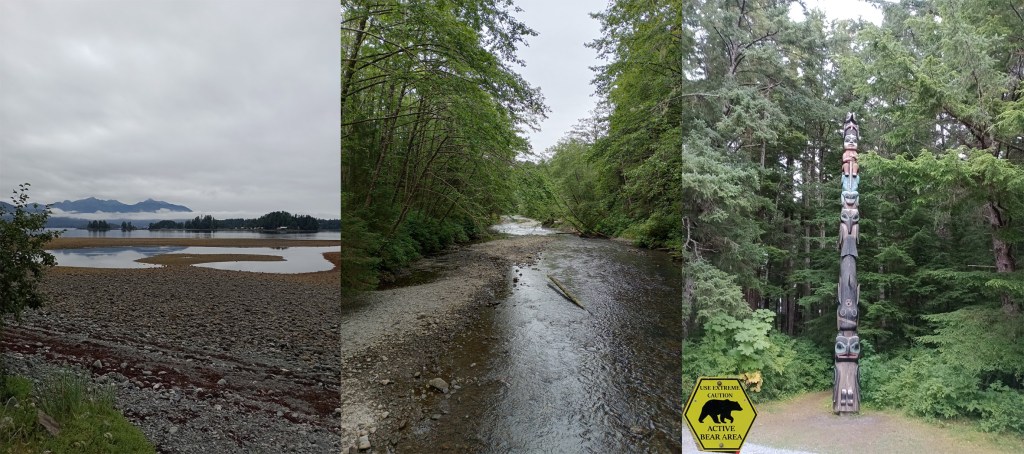
Near the centre was a river packed chock-a-block with salmon on their way upriver to spawn. There were signs of bear activity with poo and discarded salmon bones.
We walked back to town through the forest, seeing lots of ground squirrels and seeing and hearing ravens.
There was a totem path trail and one of the totems had recent bear claw marks on it. By the river were several bald eagles – they were becoming so common we started calling them pigeons.
We stopped at the visitor centre which had an exhibit on the Tlingit people. There was another Russian Orthodox church in town. An episcopalian church had a Jewish cross incorporated in the stained-glass window. A lady spoke to us about the story behind the window. The window had been ordered from the east of the country. They waited months for it and when it arrived it had the wrong design, but as they needed the window, they decided to keep it.
Icy Bay
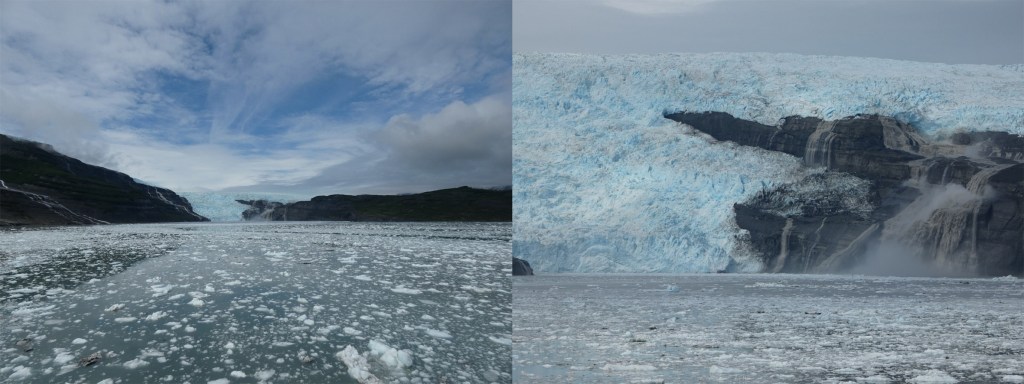
It was colder today and ice started to appear in the water as we approached Icy Bay and the Guyot glacier at its head. The glacier is over 1000 metres tall.
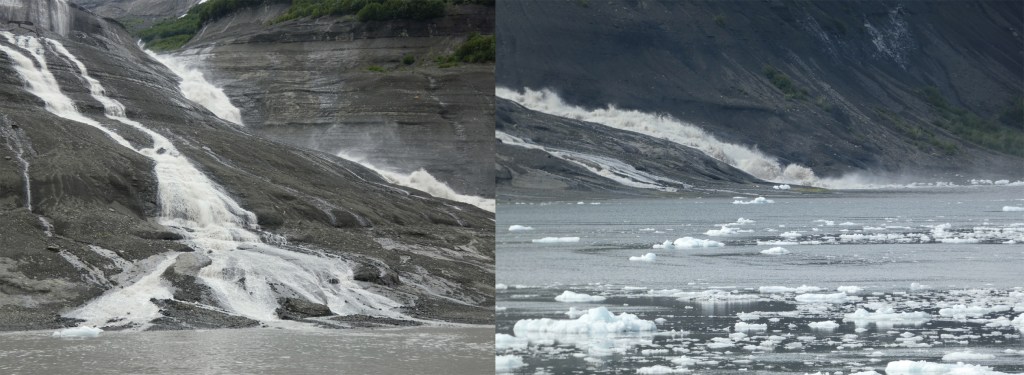
The melting glacier had waterfalls thundering down into the water. The bay was covered in bergy bits – small chunks of ice and small icebergs.
We read for a while before it was our turn to go in amongst the ice in the zodiacs.
At sea, pilots at Seward
The next day was a sea day and we went towards Resurrection Point and Seward to change pilots.
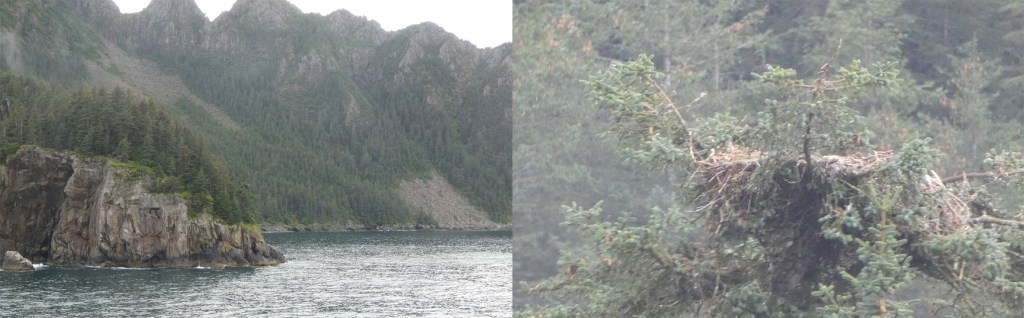
There was a bald eagle’s nest on the outcrop at the entrance to Seward.
Kukak Bay
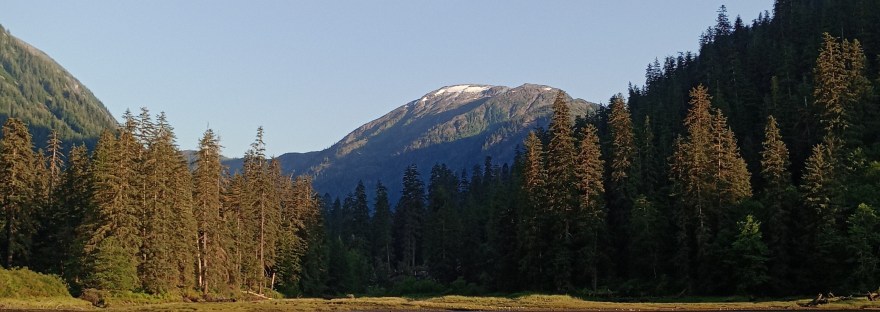
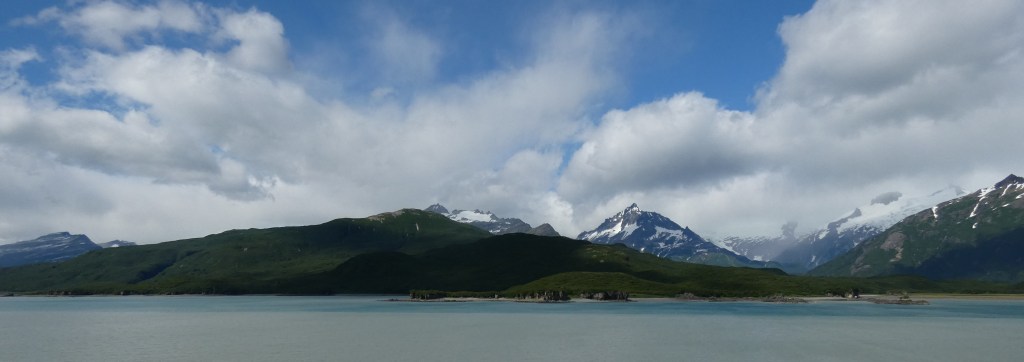
We spent the next three days in Katmai National Park. The scenery was spectacular.
First stop was Kukak Bay where we went out in the zodiacs.
We saw our first brown bears, watching one catch and eat two salmon. We named him Sam Bear.
A seal poked its head out of the water, he was named Salty Seal. There were also bald eagles around.
Moser bay
Next day we went to Moser Bay on the south side of Kodiak Island. Kodiak is the second largest island of the USA. The south side is tundra and the north, trees.
There were many fishing lines out so our ship had to stay outside and we manoeuvred in the zodiacs.
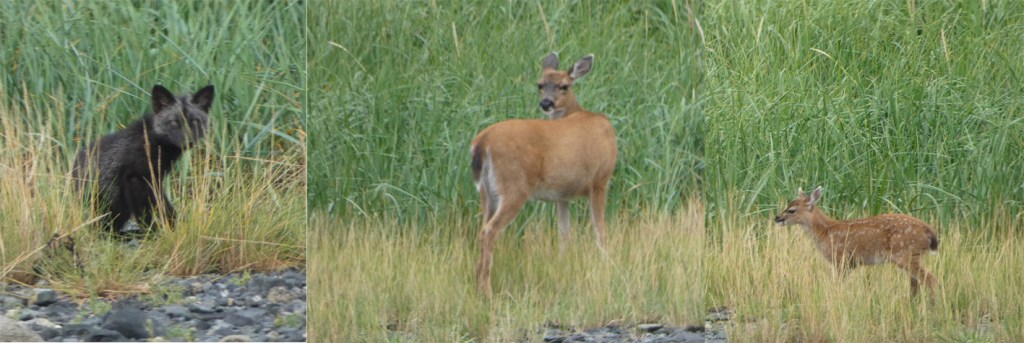
We saw an arctic (blue) fox, and spotted a mother with a young deer. We also observed a bald eagle and saw salmon jumping.
There were several humpback whales about on our way to Geographic Harbor. There were about eight or nine humpback whales including a mum and pup. We watched as they came closer and saw several tails as they dived and heard the blows of near ones. Then one of the whales jumped out of the water and breached – something we had been longing to see. It was magnificent.
Geographic Harbour
We arrived in Geographic Harbor to a sunny still day.
There was a sea otter outside the harbour that we watched floating on its back, occasionally waving a flipper or diving down.
We went in the zodiacs to the head of the bay where there were several brown bears. This time they were walking along the shore.
One brown bear went and ate some berries. We named this bear Barry.
We also saw fireweed – we know it as rose bay willow herb. It is said that when the flowers are at the top of the spike, winter is on its way.
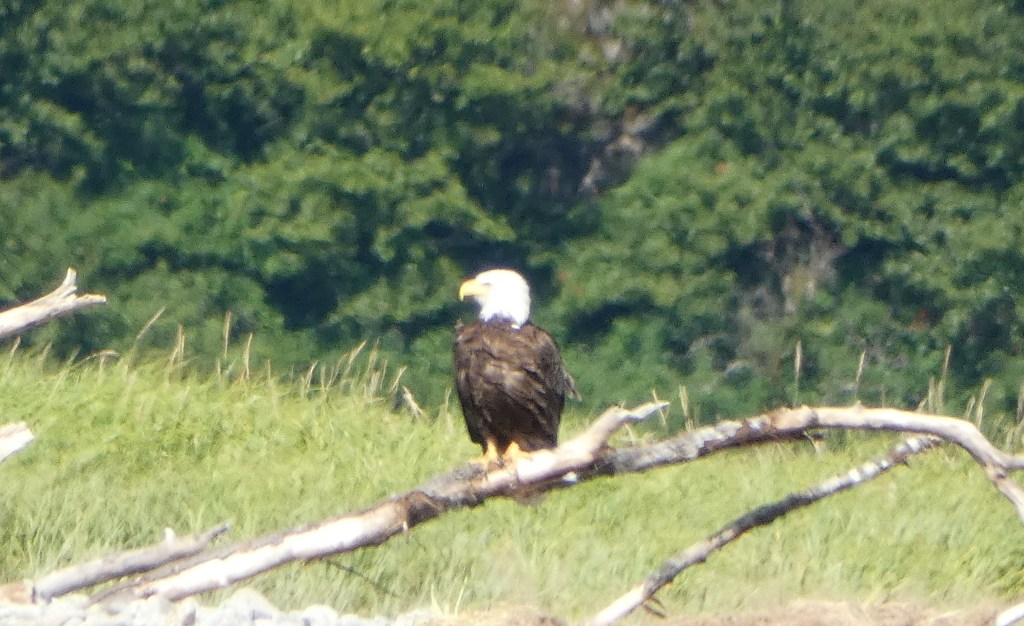
We also saw both a young and adult bald eagle. We have not seen pigeons in Alaska, but reckon bald eagles are the pigeons of Alaska as they are very common.
We also saw a belted kingfisher whizz across the edge of the water.
There were several whales on our way to Unga as well as a couple of Orcas.
Unga Island
At lunch on our way to Unga island, the waiter showed us how to make a duck using our napkins. The waiter made a perfect duck, mine was a burping penguin and my grandson made a long-tailed blind duck.
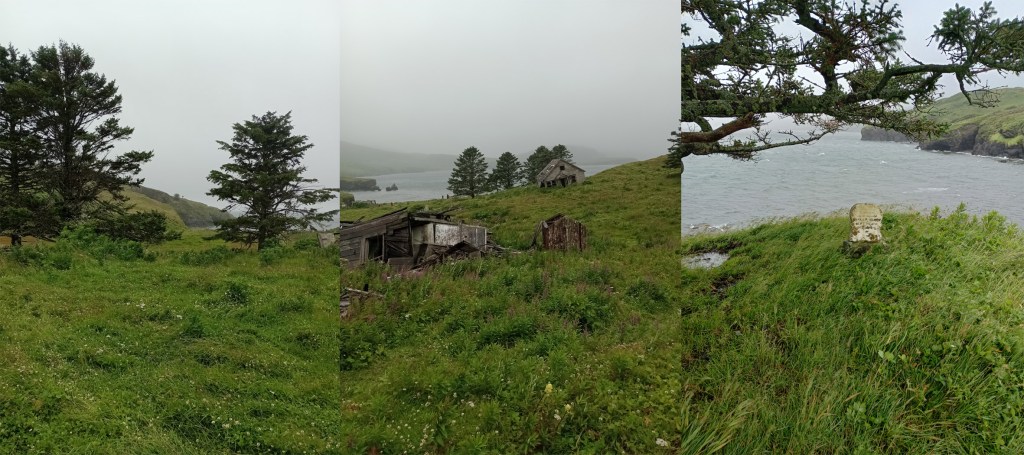
Unga was very windy and misty. It was going to be a rough wet landing.
We weren’t allowed in any of the buildings in the abandoned town. They had been taken over by nature with wildflowers everywhere. We had to watch out for cow pats from the feral cattle that had remained on the island. We didn’t see any of the cattle.
Dutch Harbor, Unalaska
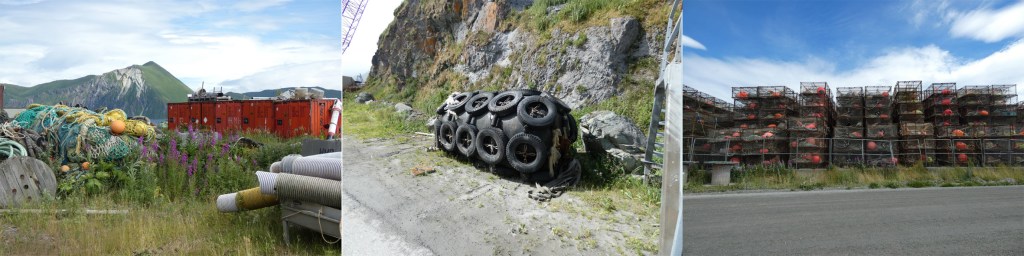
Dutch Harbour, part of Unalaska was a large town with an active port used for the fishing trade. There were piles of crab and cod pots.
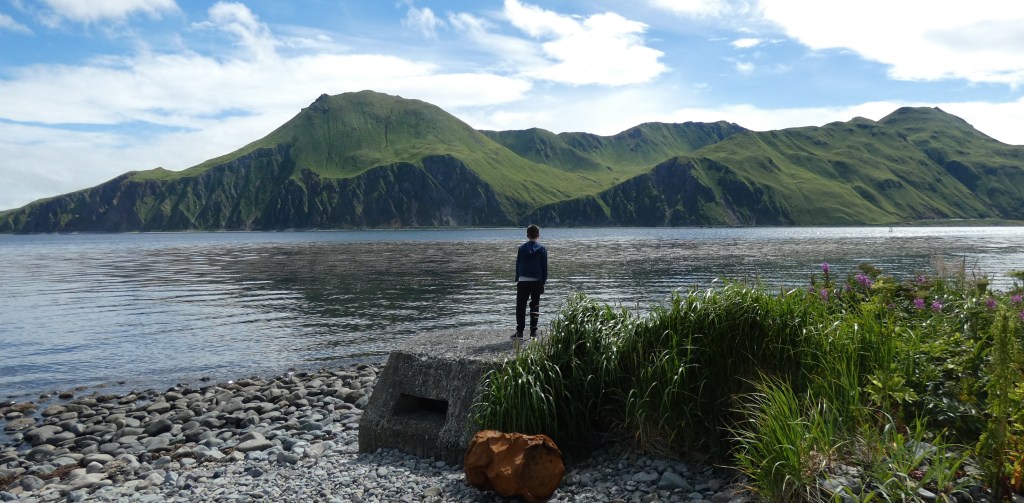
We walked along the spit, noticing lots of bald eagles including young and parents calling to each other. There were also small pipits.
By the water’s edge were several WW2 pill boxes. We had a look around the WW2 museum and also the Aleut museum. Outside the Aleut museum were some sea otters that were very close to shore. Guess who forgot their camera?
We walked back to the ship kicking stones all the way.
In Unalaska we spoke to a lady who worked with the fishing fleet. She told us the fishing boats had turned for home as there was a storm coming.
At sea, missed St Pauls, Pribliofs
The next two days were at sea. We carried on towards the Pribliof islands and it was quite rough.
There were a lot of birds including shearwaters around and we saw a couple of humpback whales.
We couldn’t land at St Pauls because the weather was wild and windy and the waves were too big on the beach for a safe landing.
We encircled the island but we were too far away and it was too misty to see much. There were lots of fur seals on the beach and cliffs of the island.
St Matthew
The weather had improved by the time we got to the uninhabited St Matthew island. There was a clear sky to begin with but then the fog rolled in while we were ashore. We were so glad to set foot on land.
On the beach we saw the footprints of a red fox which lives on the island. We also saw Rock Sandpipers bobbing in the water near the shore. They were not wary of us. We also caught sight of McKay’s Bunting. Both of these are only found on St Matthew. Puffins were nesting on the cliffs.
On the island were hundreds of singing voles. You stood still and they would come out of their holes in the undergrowth and wander around. We didn’t hear them sing which is like a squeak. The singing voles are endemic to St Matthew island.
Nome
We set sail for Nome, arriving earlier than originally planned as there were going to be strong winds which would have hindered our entrance into the harbour. We arrived in the afternoon and had time for a wander round the town before dinner.
We were warned that there might be Musk Ox in town and to run if we saw them. We didn’t see any.
We looked in the Carrie M. McLain Memorial Museum which was very interesting and well worth a visit. The telephone kiosk brought back many memories of the times before mobile phones.
The next day we went into town in the rain and wind to see a talk by a man who owns about thirty Alaskan huskies and has been in the Iditarod run four times. He brought four huskies with him.
We had a go at panning for gold and found several tiny flakes and a miniature garnet.
Then an early lunch in Old St. Joe’s before our flight to Vancouver.
Vancouver
Vancouver was a change from Nome – warm and sunny as opposed to wet and windy.
We stayed overnight in the same hotel as before. After breakfast on the 34rd floor – we both had waffles with maple syrup – we had a swim in the pool on the fourth floor.
We had a few hours before our flight back home so we went to a supermarket, then walked along the seafront, coming back via loads of stairs. At the hotel we went into the hospitality suite and played table football and jenga.
Nannie RaRa has been out and about with her camera taking photographs of nature both during her morning walks and in her garden. She is lucky in having woods, fields, a river and a wildlife site all nearby.
Here are a few pictures from those walks. I’ve named the birds as best I can, but do correct me if I have them wrong.
First up is a black cap. I heard him singing every day as I walked along the path and managed to get this photo.
Black cap
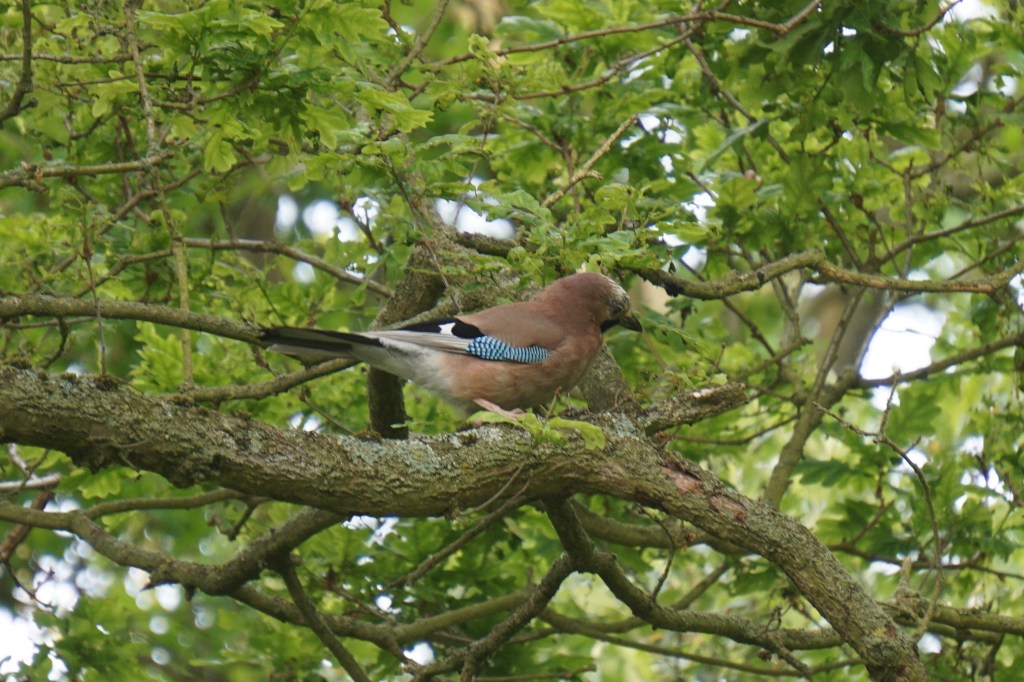
Then over the wildlife site I saw a jay. I first noticed it when a lot of the smaller birds were making a ruckus.
Jay
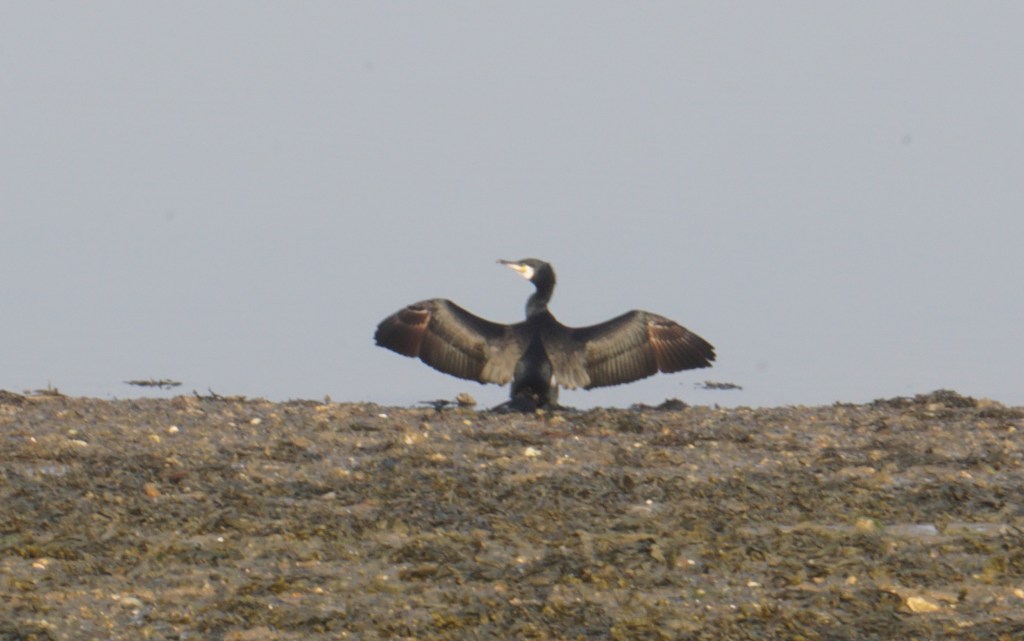
Down by the river I stood watching a cormorant drying its wings. It stood there for ages.
Cormorant
On the river one morning when it was as still as a mill pond I watched two great crested grebes doing their neck dance.
Great crested grebe
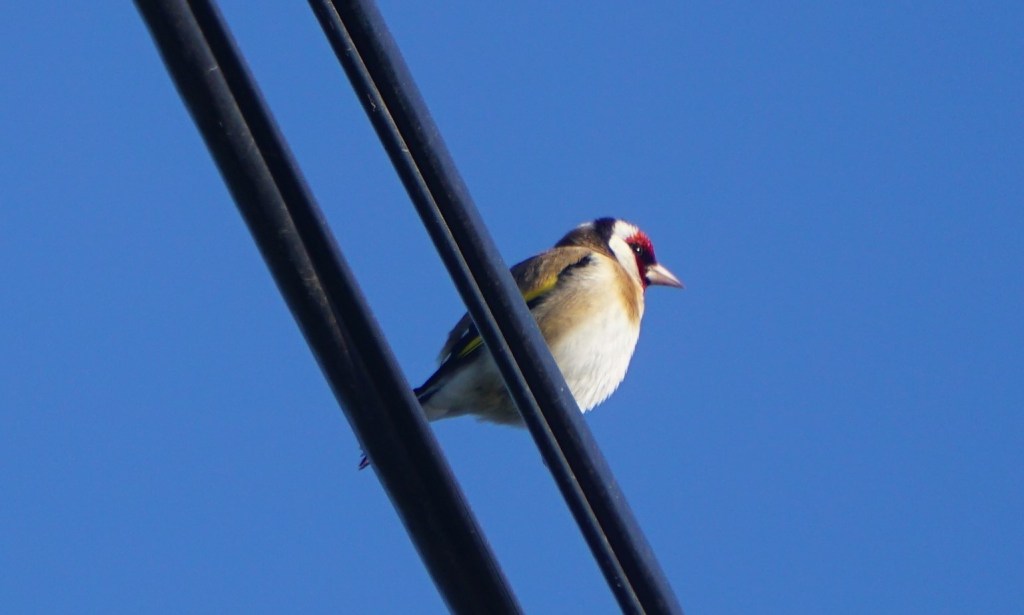
The last two photographs are not the clearest as the birds were a long way away.
A goldfinch was perched on the overhead wires.
Goldfinch
The next two photos are of a common whitethroat. It was among the brambles which were growing near a small lake on the wildlife site.
Common whitethroat Common whitethroat
This bird looks similar to the common whitethroat. Is it the same or is it a lesser whitethroat?
Lesser whitethroat (?)
Also near the lake on an old tree stump was a rook, or was it a crow?
Rook or crow
A group of long-tailed tits were in a tree.
Long-tailed tit
A chaffinch was patiently sitting on a twig.
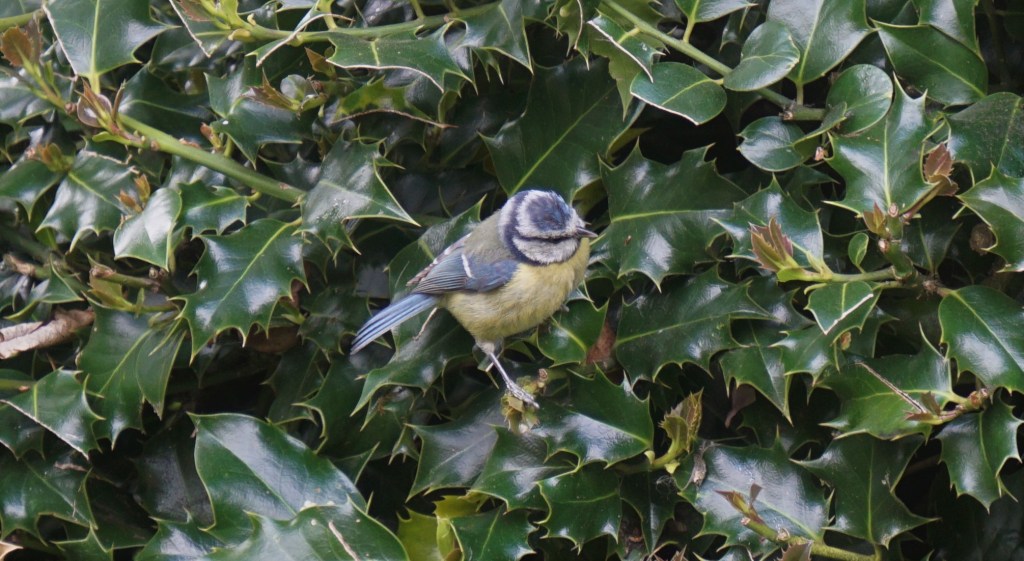
This bluetit was taken in the garden as it was looking for insects among the holly.
Bluetit
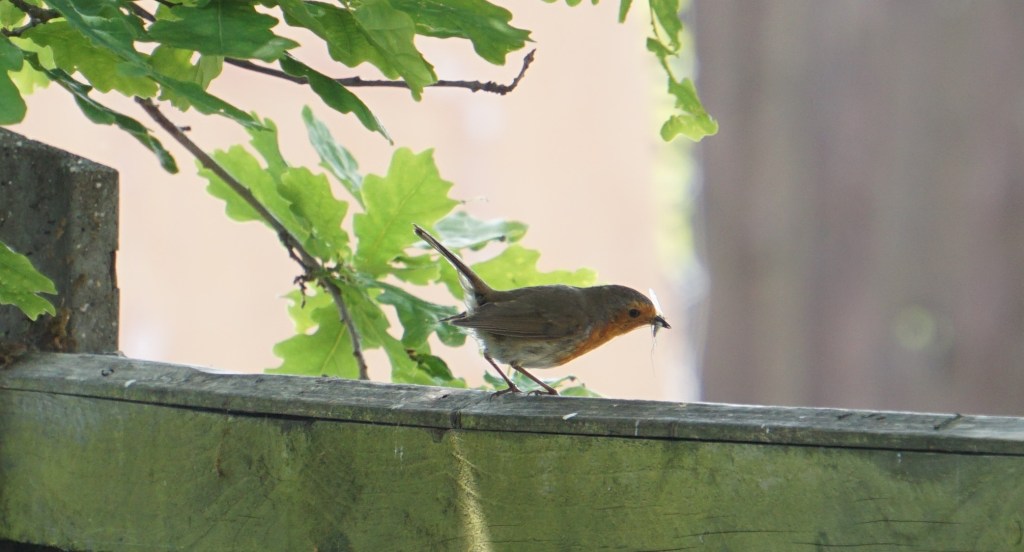
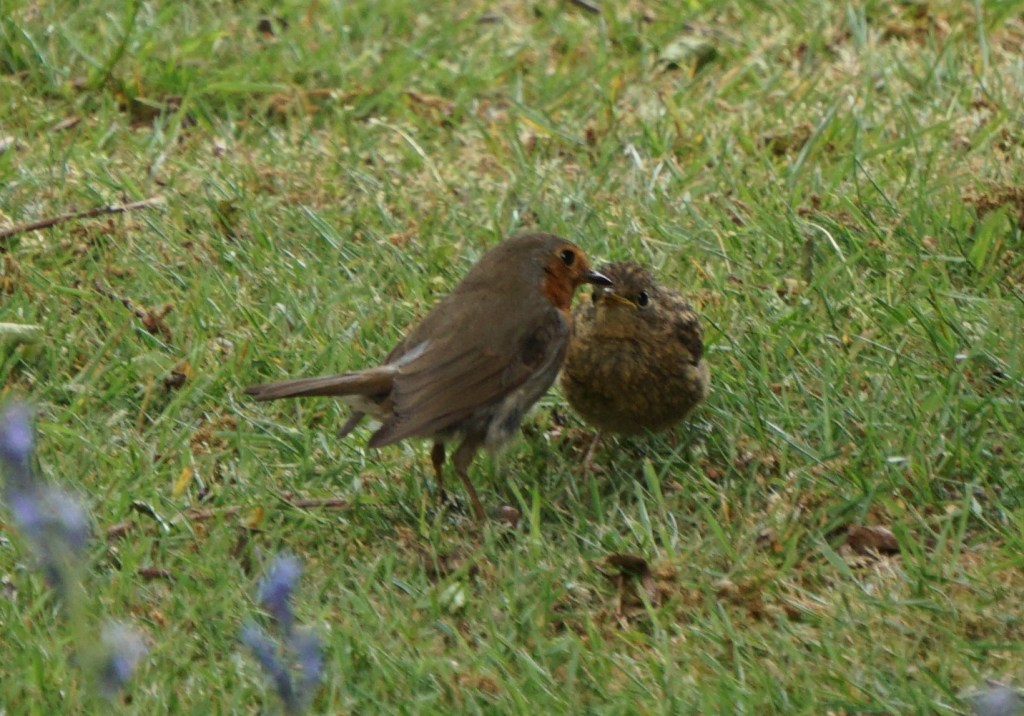
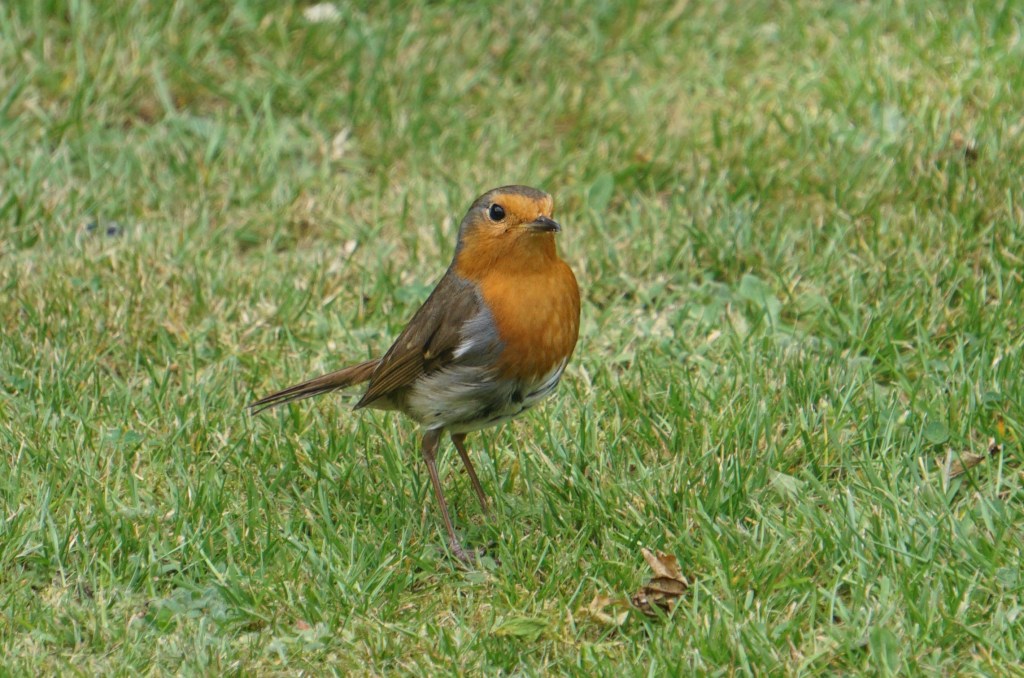
Nearby there have been some robins nesting. First I saw the male robin with insects in its beak. Then the baby robins appeared and were fed for a while before finding their own food.
Robin with insectsFeeding the baby robinYoung robinAdult robin
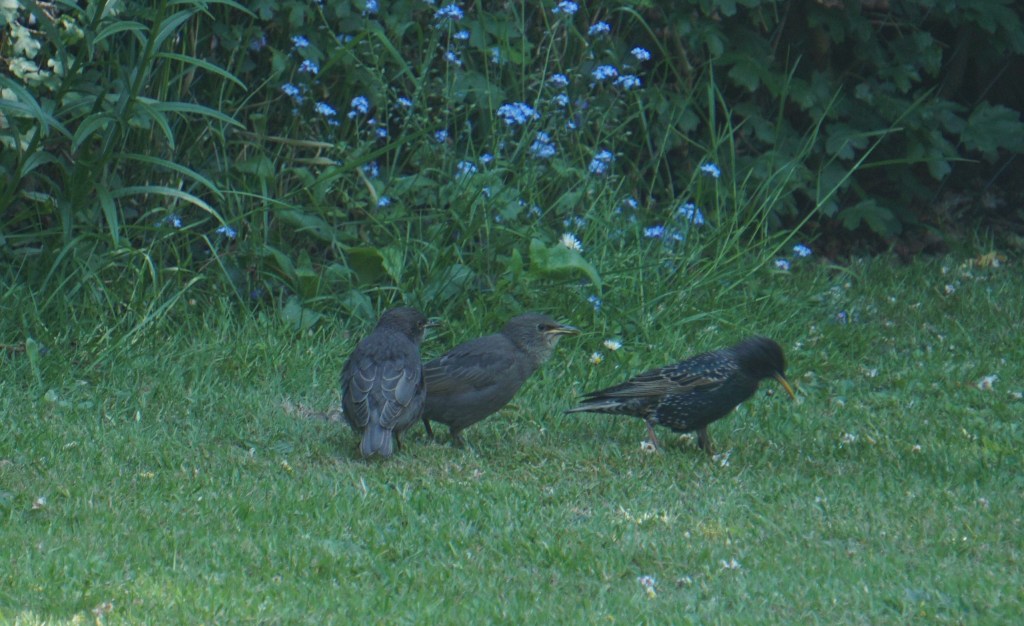
There was a family of starlings in the garden looking for food. The young sat there waiting to be fed, then opend their mouths and squawked when they couldn’t wait any longer.
Starlings looking for foodYoung starling squawking for food
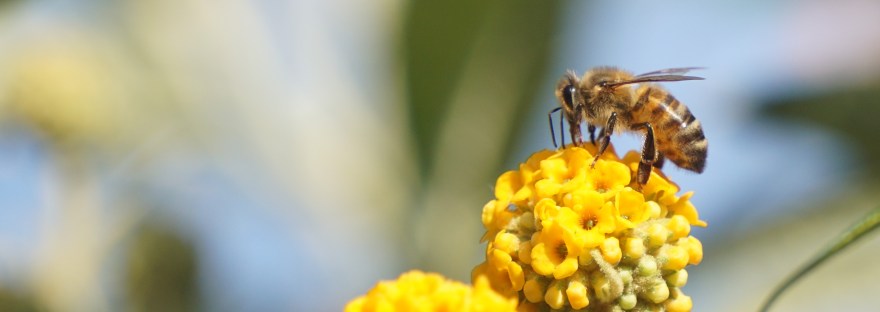
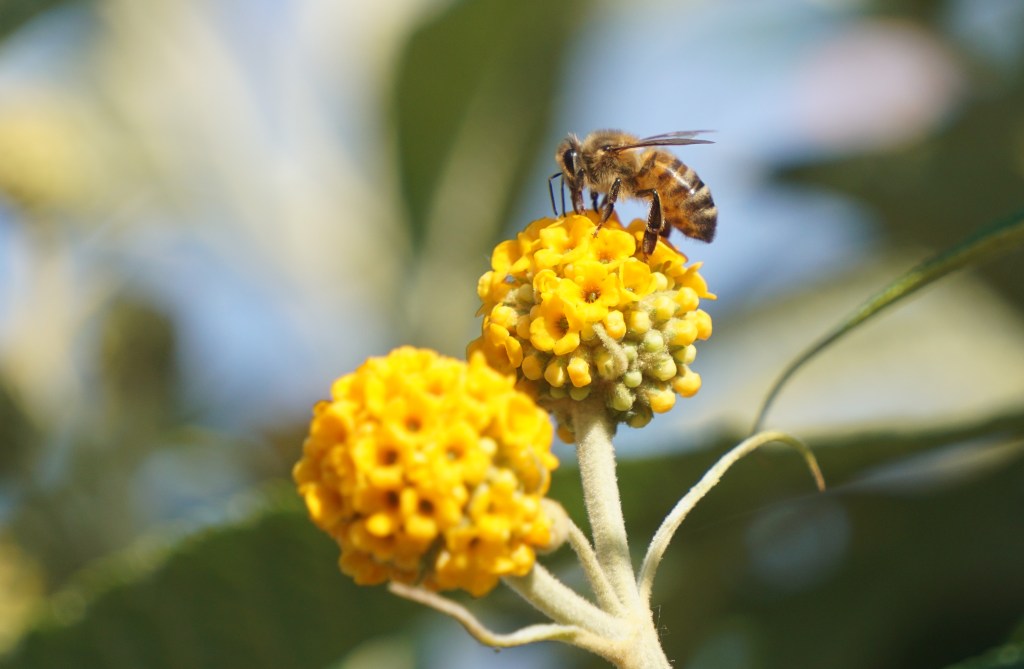
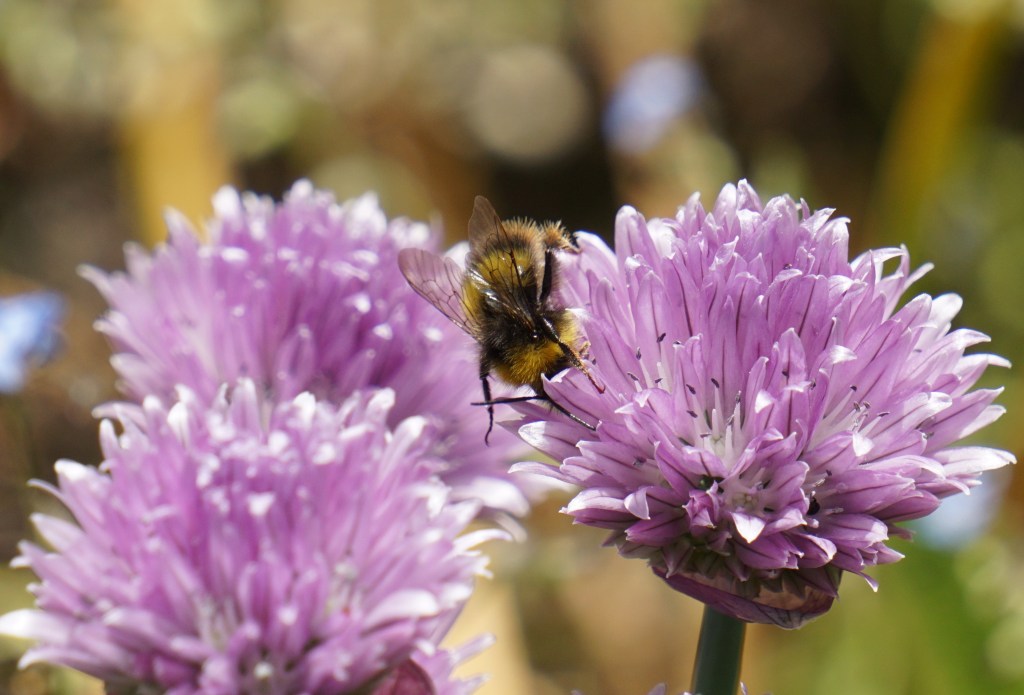
Finally there are a few photographs of insects found in the garden.
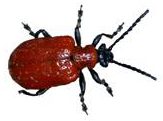
Honey bee on orange buddleiaBumble bee diving into a chive flowerAnd finally a dreaded lily beetle
Do let me know if any of the birds are mis-identified. Nannie RaRa is fairly new to birdwatching and to photographing them. There are so many blurry photos I won’t show you.

















 Nannie RaRa